Short answer: WhatsApp marketing works for D2C brands when customers have opted in and each message is useful. Meta charges per delivered message, by category: marketing, utility, authentication and service. Since 1 October 2026, utility replies and service messages beyond 1,000 a month are also charged. Start with order updates, COD confirmation and cart reminders.
For most Indian D2C brands, WhatsApp is where customers already talk to them. They ask about sizes, check on orders and send photos of damaged parcels. That makes it a strong channel for repeat sales, and an easy one to misuse.
This guide explains how Meta prices WhatsApp messages now, what changed on 1 October 2026, the opt-in rules, and the flows we set up first. Pricing rules change often. Meta can change rates on the first day of any quarter, so check the official pricing page before you budget.
How does WhatsApp Business Platform pricing work in 2026?
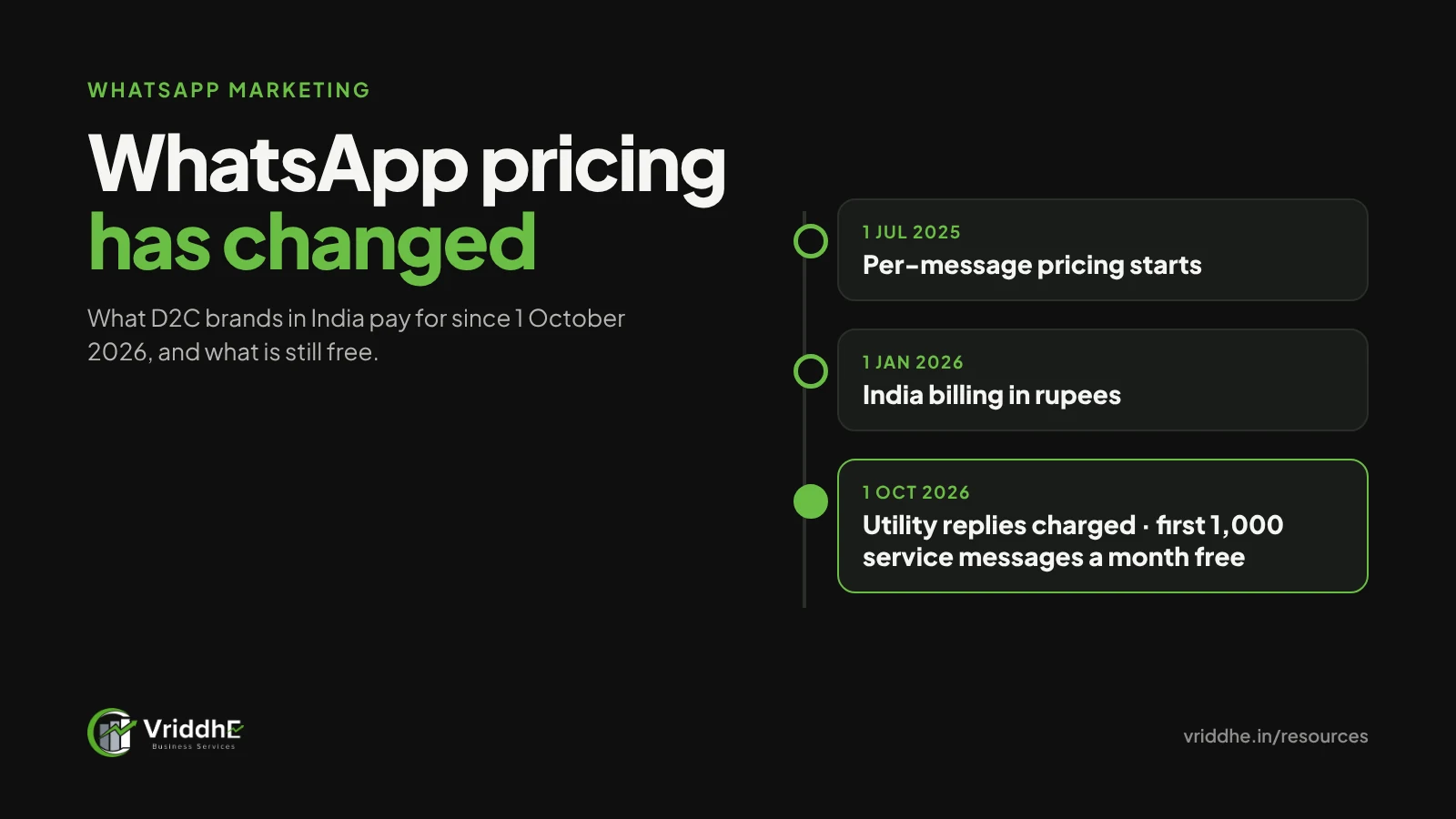
Meta charges per message delivered, not per message sent, and the price depends on the message category and the customer’s country code. Per-message pricing replaced conversation-based pricing on 1 July 2025. Messages customers send to you are free.
There are four categories that matter for most brands:
| Category | What it is for | When you can send it |
|---|---|---|
| Marketing (template) | Offers, launches, cart reminders, win-back | Any time, to opted-in customers |
| Utility (template) | Order confirmations, shipping updates, COD confirmation | Any time, linked to an order or account |
| Authentication (template) | One-time passwords and login codes | Any time |
| Service (free-form) | Replies to a customer who messaged you | Only inside the 24-hour customer service window |
A customer service window opens when a customer messages or calls you, and runs for 24 hours. Each new message from them resets it.
India-specific notes from Meta’s pricing page: India’s marketing rate rose from 1 January 2026, and India billing moved to rupees from the same date. Meta publishes the actual rates in rate cards on that page; use the INR card.
What changed on 1 October 2026?
Two things that used to be free are now charged. Utility messages sent in reply inside a customer service window are now charged per message. Service messages are charged too, after a free tier of 1,000 service messages a month per business phone number.
| Message type | Before 1 October 2026 | From 1 October 2026 |
|---|---|---|
| Service replies | Free since 1 November 2024 | First 1,000 a month free per number, then charged |
| Utility replies inside the 24-hour window | Free since 1 July 2025 | Charged per message |
| Marketing templates | Charged | Charged |
What this means in practice: a support team that answers hundreds of customer chats a day will now see a bill for those replies. Review how many messages each support conversation takes, and whether a better first reply would save two follow-ups.
One thing is still free: when a customer messages you from a Click to WhatsApp ad and you reply, Meta opens a free entry point window that can stay open for up to 7 days. In that window, Meta does not charge for marketing, utility, authentication or service messages.
What are the opt-in rules for WhatsApp marketing?
You must get the customer’s opt-in before messaging them. Meta says the opt-in must clearly state that the person is agreeing to receive messages from your business, and must name your business. It must also follow local law.
Meta allows you to collect opt-in in several ways, including your website, SMS, an IVR phone flow, or in person. For a D2C store, the usual places are:
- A tick box at checkout: “Send me order updates and offers from [Brand] on WhatsApp.”
- A pop-up or signup form with a separate WhatsApp option.
- A customer messaging you first, after which you ask whether they want updates.
Meta recommends separate opt-ins for different types of messages, such as order updates and offers, and clear instructions for opting out. We follow that: customers who only want order updates should not get sale blasts.
In India, also follow the Digital Personal Data Protection Act, 2023 on consent and data use. Check the details with your legal adviser.
Which WhatsApp flows should a D2C brand set up first?
Start with flows tied to an order, because customers expect them and they reduce support load. Add promotional flows once those run smoothly.
The four we set up first, in order:
- Order confirmation and shipping updates (utility). Fewer “where is my order?” chats.
- COD order confirmation (utility). Ask cash-on-delivery customers to confirm before you dispatch. It catches fake or impulse orders before they turn into return-to-origin costs.
- Abandoned cart reminder (marketing). One reminder, sent within a few hours, with the product image and a link back to the cart.
- Post-delivery check-in (utility or marketing, depending on content). Ask whether the product arrived well, share care tips, and ask for a review.
After these, add replenishment reminders for consumables and win-back messages for customers who have not ordered in a while. Our guide on repeat customer economics explains why those matter for profit.
These flows need your store to send events to a WhatsApp provider. On Shopify this is usually an app connection; our Shopify development team can set it up.
How do you work out if a WhatsApp campaign pays back?
Multiply the messages delivered by Meta’s rate for that category, add your provider’s fee, and compare that cost with the profit from orders the messages bring back. Use your own conversion data, not someone else’s benchmark.
A worked example for an abandoned cart flow. The numbers are illustrative. We use ₹1 per message only to keep the maths simple; it is not Meta’s rate.
| Line | Value |
|---|---|
| Carts abandoned by opted-in customers in a month | 2,000 |
| Reminders delivered (one each) | 2,000 |
| Meta cost at an assumed ₹1 per marketing message | ₹2,000 |
| Provider fee (check your plan) | ₹X |
| Orders recovered, if 3% come back | 60 |
| Average order value | ₹1,500 |
| Recovered revenue | ₹90,000 |
| Profit at a 35% margin after product, shipping and fees | ₹31,500 |
Here the flow pays back easily. It will not always. If your recovery rate is close to zero, or you send three reminders where one would do, the cost rises and customers start blocking you.
How do you avoid blocks and low quality ratings?
Send fewer, more relevant messages. WhatsApp tracks your quality rating, and Meta says it will limit how many messages a business can send if quality stays low for a sustained period. Customers can also stop marketing messages, block you or report you.
What we do:
- Segment by purchase behaviour. Someone who bought last week does not need the same offer as someone who has not bought in six months.
- Keep marketing messages to a set frequency, and stop them for anyone who does not engage.
- Respect WhatsApp’s per-user limits. Meta caps how many marketing messages each person receives from all businesses. If you hit that cap, delivery fails with error 131049, and Meta says to wait at least 24 hours before trying again.
- Give every marketing message an easy way to opt out.
Common mistakes, and when this does not apply
Common mistakes:
- Uploading a purchased or old contact list. These people did not opt in, and blocks follow.
- Sending offers to everyone on the list every week.
- Classifying promotional content as utility to pay less. Meta reviews templates and can re-categorise them.
- Budgeting with old rules. Service and utility replies now cost money.
- Running WhatsApp campaigns with no link to store data, so customers get reminders for items they already bought.
When this does not apply:
- You use the free WhatsApp Business app on one phone rather than the Business Platform (API). Platform pricing and template rules do not apply the same way, but you also cannot automate flows at scale.
- Your customers are mostly outside India. Rates and rules differ by country, and Meta does not currently deliver marketing templates to US phone numbers.
- You sell only on marketplaces. Amazon and Flipkart customers are not your opted-in contacts; message them only through each marketplace’s own tools.
FAQ
Is WhatsApp Business API free in India?
No. Meta charges per delivered message by category. Messages customers send you are free, and the first 1,000 service messages a month per business number are free from 1 October 2026.
What is the difference between marketing and utility messages?
Marketing messages are promotional, such as offers and cart reminders. Utility messages are transactional, such as order confirmations and shipping updates.
Are WhatsApp service messages still free?
From 1 October 2026, each business phone number gets 1,000 free service messages a month. Messages beyond that are charged.
Do I need a provider to use the WhatsApp Business Platform?
Most brands use a Meta business partner or a CRM tool that connects to the Platform. Large teams with developers can connect directly.
How often can I send marketing messages?
There is no single number. Meta limits marketing messages per user based on their engagement, so relevance matters more than frequency.
Can I message customers who bought from me on Amazon?
Only through Amazon’s own buyer-seller messaging tools and within its rules. A marketplace order is not a WhatsApp opt-in.
Want help setting up WhatsApp flows?
We set up and run WhatsApp, email and SMS flows for D2C brands, along with customer support. See our CRM and customer support service and how we work with brands on Shopify, or book a free growth audit and we will look at your current retention flows.