Short answer: Run Amazon ads yourself if you have a few products, time every week and a clear margin per product. Hire in-house when ads are a large, steady cost and you want daily control. Use an agency when you need experience across many accounts quickly, and only if its fee is smaller than the profit it can add.
We run an Amazon PPC agency, so read this with that in mind. We have still tried to write the page we would want a friend to read before signing with anyone, including us. For many small brands, the honest answer is to run ads yourself for the first few months.
Three terms we use: ACoS is ad spend ÷ sales from ads × 100 (Amazon’s definition). TACoS is ad spend ÷ total sales (ads plus organic) × 100. ROAS is sales from ads ÷ ad spend. The ad types are Sponsored Products (SP), Sponsored Brands (SB) and Sponsored Display (SD); our guide to the three ad types explains each.
What work does Amazon PPC actually involve?
Amazon PPC is a weekly routine, not a one-time setup. Whoever runs it needs to do the same checks every week, and some every day, for as long as you advertise.
| How often | Task |
|---|---|
| Daily | Check budgets on top products, catch campaigns that ran out early, watch for stock-outs that waste spend |
| Weekly | Download search term reports, add winning searches as keywords, add negatives, adjust bids by ACoS against margin |
| Monthly | Review TACoS and organic rank, rebalance budget across SP, SB and SD, plan for sale events |
| Before sale events | Raise budgets, set bid plans, check stock and coupons |
| Ongoing | Fix listing issues that hurt conversion, because ads cannot fix a weak product page |
If no one in your team can give this routine a fixed slot every week, that alone is a reason not to run it yourself.
When should you run Amazon ads yourself?
Run ads yourself when your catalogue is small, the founder or a team member can protect a weekly slot, and you know the margin on each product. This is the cheapest way to learn what works, and nobody will care about your margin more than you.
DIY works best when:
- You have a handful of products, not hundreds.
- Monthly ad spend is small enough that a mistake costs little.
- You are willing to learn the console, the reports and the basics of match types.
- You can set a break-even ACoS per product. Our ACoS playbook shows how.
The risk with DIY is not skill. It is time. Most founders we meet started well, then stopped mining search terms when the business got busy, and the account drifted.
When does an in-house PPC hire make sense?
Hire in-house when ad spend is large and steady enough that one person’s full attention pays for itself, and you have someone senior who can check their work. An in-house person knows your products, stock and margins better than any outsider.
In-house works best when:
- Amazon is a main channel, not a test.
- You have enough products and campaigns to fill a full-time role.
- Someone in the business can review their decisions each month.
The downsides are real too. One person sees one account, so they learn only from your data. If they leave, the knowledge often leaves with them. And a junior hire without a senior reviewer can repeat the same mistake for months.
When is an agency the better choice?
Choose an agency when you need experienced hands quickly, run several marketplaces, or want a team that has seen many accounts in your category. A good agency brings pattern recognition that one in-house person cannot build alone.
An agency works best when:
- You want SP, SB and SD running properly within weeks, not after months of learning.
- You sell on Amazon plus Flipkart or other channels and want one team for all of them.
- You have a busy period ahead, such as a sale event, with no time to learn.
The downsides: an agency knows your business less closely than your own team, attention can thin out across many clients, and fees add a fixed cost. That is why the next section matters.
How do you know if an agency fee will pay back?
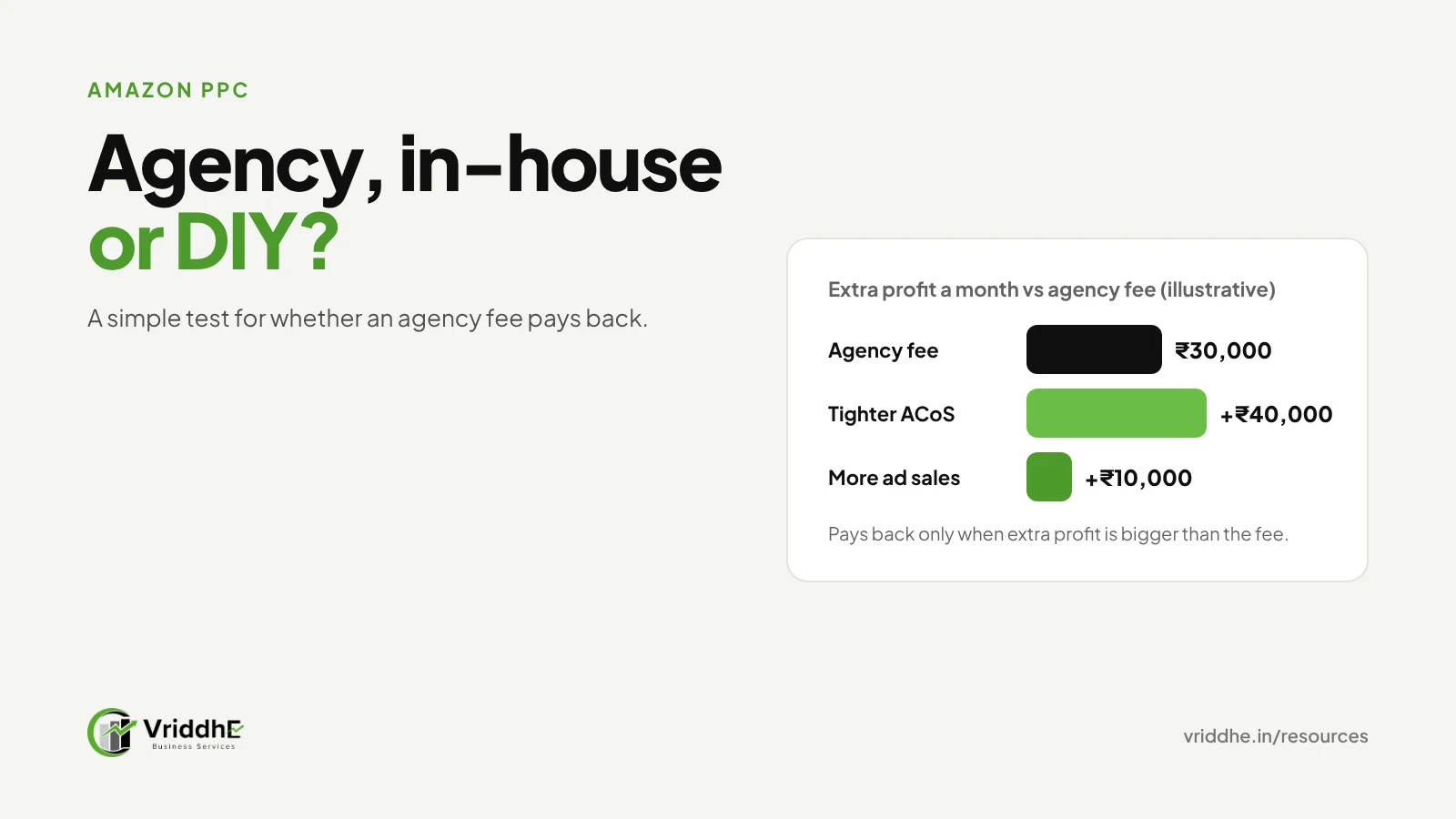
Compare the fee with the extra profit the agency can realistically add. If better ad efficiency or extra sales add more profit each month than the fee costs, it pays back. If not, run ads yourself or hire.
A worked example. These numbers are illustrative, not a benchmark or a quote.
A brand spends ₹2,00,000 a month on Amazon ads and gets ₹8,00,000 in ad sales. ACoS is 25%. Its margin before ads is 30%, so each ad sale makes a small profit.
| Scenario | Ad spend | Ad sales | ACoS | Profit from ad sales before fee (30% margin − ad spend) |
|---|---|---|---|---|
| Today | ₹2,00,000 | ₹8,00,000 | 25% | ₹40,000 |
| Same sales, tighter structure | ₹1,60,000 | ₹8,00,000 | 20% | ₹80,000 |
| More sales at today’s ACoS | ₹2,50,000 | ₹10,00,000 | 25% | ₹50,000 |
In the second row, profit rises by ₹40,000 a month. Suppose an agency quotes ₹30,000 a month. The fee pays back with ₹10,000 left over, and that is before any lift in organic sales.
In the third row, profit rises only ₹10,000. The same ₹30,000 fee would lose money unless organic sales grow too, which is why we also watch TACoS.
Ask any agency, including us, which row it thinks your account can reach and why. A believable answer refers to your search term report, not a promise.
For a real reference, on one décor brand ACoS moved from 28% to 20% while revenue grew around 20% month on month, alongside listing and IP protection work. The Gold Art India case study explains what changed. Your result depends on your products, margins and category.
What should you ask before hiring an Amazon PPC agency?
Ask questions that show how they work, not how they sell. Amazon’s own partner guide suggests checking expertise, the level of support, how involved you want them to be, their track record and the contract length, and getting proposals from several partners.
Our checklist:
- Who owns the account? You should stay the owner of Seller Central and the Ads console, and add the agency as a user. Never hand over your login.
- What will the first 30 days look like? Expect an audit, a target ACoS per product and a campaign plan.
- What will you report on? ACoS alone is not enough. Ask for TACoS, organic rank on main keywords and spend against margin.
- Who works on my account? Ask to meet the person who will change your bids, not only the salesperson.
- What is your notice period? Prefer a short notice period over a long lock-in.
- Are you listed in the Amazon Ads partner directory? Amazon gives verified and advanced status badges to partners that meet its criteria. Check the directory rather than trusting a logo on a website.
- Can I see a case study in my category? And can they explain what they did, not only the result?
Common mistakes, and when this does not apply
Common mistakes:
- Choosing on the lowest fee. A cheap fee on a badly run account costs more in wasted spend.
- Paying a fee that is a percentage of ad spend without a cap. It rewards spending more, not spending better. Ask how the fee is set.
- Handing over the account login instead of adding the agency as a user.
- Judging an agency in the first two weeks. Restructuring takes a few weeks to settle.
- Hiring anyone before fixing the listing. Ads send traffic; the product page decides if it converts.
When this does not apply:
- Your product is not ready for ads: few or poor reviews, weak images or frequent stock-outs. Fix those first.
- You sell in a restricted category where ads are limited.
- You are a vendor working with an Amazon vendor manager. Your options and reporting differ.
FAQ
How much does an Amazon PPC agency charge in India?
Fees vary widely, so we do not quote an average. Common structures are a fixed monthly fee, a percentage of ad spend, or a fixed fee plus a performance-linked part. Compare any quote with the profit test above.
Is a freelancer a good middle option?
It can be, for a small account. Check the same things you would with an agency: account ownership, reporting and who backs them up when they are unavailable.
Can I run Amazon ads myself and use an agency only for setup?
Yes. Some brands pay for a one-time audit and campaign build, then run the weekly routine in-house.
What is an Amazon Ads Verified Partner?
A partner in the Amazon Ads Partner Network that Amazon has given verified status, based on its own criteria for expertise and results. You can check status in Amazon’s partner directory.
How long before an agency shows results?
Expect the first month for audit and restructuring. Judge direction by the end of month two, and judge results on TACoS and profit by month three.
Should one agency run both Amazon and Flipkart ads?
It helps if they do both well, because budgets can move between channels. Ask for examples on each marketplace.
Want to compare notes on your account?
If you would like a second opinion before you decide, we will review your campaigns and tell you honestly whether you need an agency at all. See how our Amazon PPC management works and our engagement models, or book a free growth audit.